Tech Futures Slide as Canada Tariffs Reopen Trade Risk

U.S. stock futures begin the week with a technology-led pullback as a new U.S.-Canada tariff fight, another weak Asian semiconductor session, and Wednesday's Nvidia earnings raise the hurdle for growth shares. S&P 500 futures are down 0.27%, Dow futures decline 0.15%, and Nasdaq 100 futures lose 0.70%. The gap between the Nasdaq and Dow matters: this is a concentrated valuation and chip-risk reset so far, not indiscriminate liquidation.
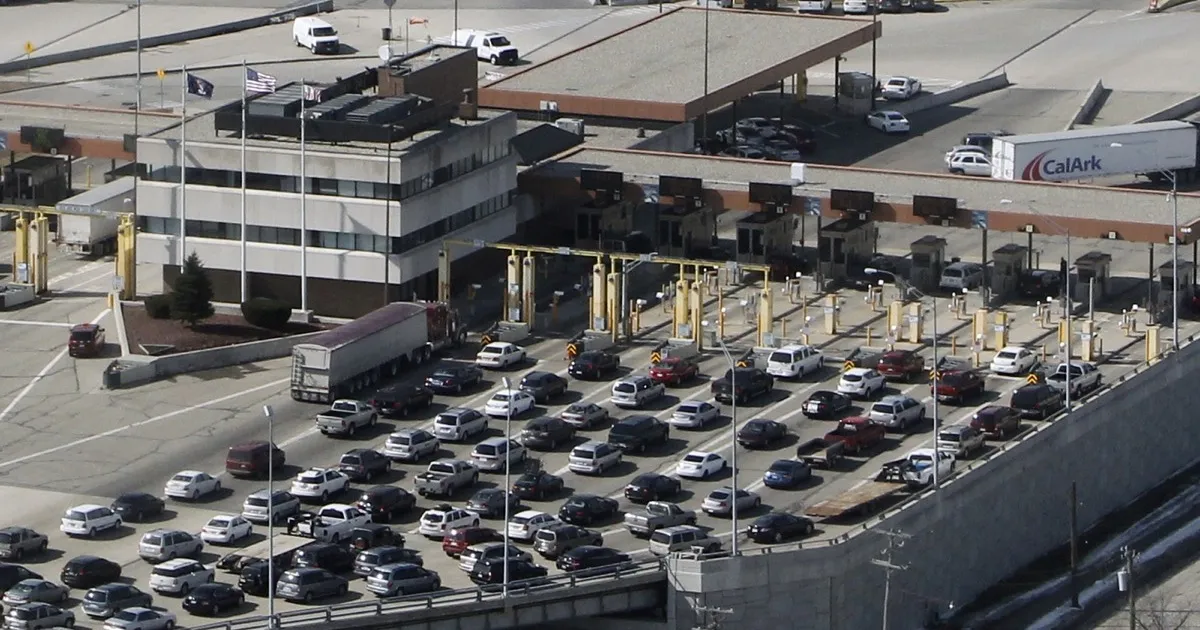
Trade policy is the main new catalyst. U.S.-Canada talks broke down Friday, and the United States imposed 50% tariffs on about $20 billion of Canadian goods on Saturday. Canada said dollar-for-dollar retaliation will begin September 8, targeting sectors that include steel, dairy, appliances, agricultural equipment, pulp and paper, and electronics. The direct macro effect will take time, but the immediate market question is whether automakers, industrial suppliers, and retailers face another round of margin pressure or delayed investment.
The previous AlphaEdge morning base case projected an S&P 500 range of 7,615-7,695 and required a close above 7,670 for stabilization. Friday's 7,674.37 close completed both tests. Yet the 10-year Treasury yield rose to 4.74%, and Monday's Nasdaq weakness shows that stabilization did not become broad confirmation. Investors are entering the week willing to hold risk, but still unwilling to ignore the discount-rate and policy risks surrounding premium technology valuations.
Pre-Market Snapshot
| Instrument | Level | Change |
|---|---|---|
| S&P 500 futures | 7,670.25 | -0.27% |
| Dow futures | 53,274 | -0.15% |
| Nasdaq 100 futures | 29,181.25 | -0.70% |
| VIX | 15.95 | +5.42% |
| 10-yr Treasury | 4.74% | Friday close |
| Gold futures | $4,701.90 | +0.46% |
| WTI crude | $85.17 | -2.17% |
| EUR/USD | 1.1667 | -0.09% |
| Bitcoin | $77,469 | -0.33% |
Futures, volatility, commodities, currency, and digital-asset prices as of approximately 7:10 a.m. Eastern. The Treasury yield is Friday's closing reference.
Overnight Developments
Canada tariffs reopen the North American margin debate
The failed trade talks are more important than the headline value of the first tariff list. According to Associated Press reporting, two-way U.S.-Canada trade totaled about $880 billion last year. The last-minute U.S. terms reportedly included limited relief for Canadian vehicles and restrictions affecting Canada's other trade agreements. That creates uncertainty beyond the targeted goods because North American auto, metals, paper, agricultural, and electronics supply chains cross the border repeatedly before a final sale.
For equities, the transmission channel is margins first and demand second. Companies can absorb the duties, seek exemptions, move sourcing, delay shipments, or pass costs to customers. Each choice has a different earnings effect, but none improves near-term visibility. Dow futures outperforming Nasdaq futures may look counterintuitive for an industrial trade shock. It is better read as relative valuation support for lower-multiple shares while the market waits to see which companies have the most direct Canadian exposure.
Iran sanctions rise while oil prices retreat
U.S. officials are expected to outline additional Iran sanctions later Monday, including secondary measures aimed at countries that continue doing business with Tehran. Iran has warned that governments supporting the restrictions will be treated as committing an act of war. The language keeps shipping, insurance, and supply disruption risk elevated even as the immediate price response moves the other way.
WTI crude has fallen 2.17% to $85.17 and Brent trades near $93. The decline provides an important cushion for consumers and long-duration equities because it reduces the marginal inflation impulse from energy. It also says traders are not yet pricing an immediate physical shortage. This split can change quickly: sanctions are a policy event, while oil futures are a real-time probability market. A rebound in WTI above $87 would remove one of Monday's few macro offsets.
Global Markets
Asia delivered the clearest risk-off signal. South Korea's Kospi fell 3.1% to 6,696.96, Hong Kong's Hang Seng lost 1.9% to 25,517.33, Japan's Nikkei 225 declined 0.7% to 65,537.33, and the Shanghai Composite slipped 0.6% to 3,881.40. Australia's ASX 200 moved against the trend, rising 0.5% to 9,102.90. The scale of the Kospi decline keeps semiconductor positioning at the center of the U.S. open, especially with Nvidia due to report Wednesday.
Europe is notably calmer. Germany's DAX is almost unchanged near 26,139.33, France's CAC 40 is flat near 8,483.76, and the Euro Stoxx 50 is flat near 6,460.66. Britain's FTSE 100 gains 0.3% to 10,843.73. The regional divergence suggests that Monday's pressure is linked more closely to Asian technology and U.S. policy risk than to a generalized global growth scare.
Friday's U.S. close established a firmer cash anchor. The S&P 500 added 0.4% to 7,674.37, the Dow rose 1.0% to 53,277.01, and the Nasdaq Composite gained 0.4% to 26,180.45. The Russell 2000 finished at 3,017.87. Even after the rebound, the S&P 500 lost 1.4% for the week and the Nasdaq dropped 2.1%, leaving investors sensitive to another failed technology recovery.
Macro and Rates
The 10-year Treasury yield ended Friday near 4.74%, up from roughly 4.69% Thursday, while the 30-year closed near 5.27%. Strong August business surveys kept the soft-landing narrative intact but also maintained a high discount-rate hurdle. The flash services PMI reached 56.8 and the composite measure rose to 56.0. Growth that strong supports revenue expectations, yet it offers little reason for bond investors to anticipate rapid policy easing.
The dollar index rises 0.20% to 99.00, while the euro eases to 1.1667. Gold advances 0.46% to $4,701.90 despite the firmer dollar. That combination reflects continued demand for geopolitical and policy hedges. Bitcoin is nearly unchanged around $77,469 after Friday's regulatory optimism drove sharp gains in crypto-linked equities. Cross-asset signals therefore remain mixed: oil relief is disinflationary, but gold strength and a firm dollar show that investors have not dismissed policy risk.
Monday's domestic data slate is light. The Chicago Fed National Activity Index for July arrives at 8:30 a.m. Eastern, followed by the Chicago Fed Survey of Economic Conditions at 10:00 a.m. The New York Fed updates its Survey of Consumer Expectations labor-market data at 11:00 a.m. None is likely to replace tariffs, oil, or Nvidia positioning as the primary index driver, but a stronger CFNAI would reinforce the higher-for-longer rate message.
Corporate News
PDD Holdings reported second-quarter revenue of RMB112.36 billion, or $16.56 billion, up 8% from a year ago but below the roughly $16.99 billion consensus. Non-GAAP diluted earnings were RMB19.33, or $2.85 per ADS, above consensus near $2.73. Operating profit rose 8%, while non-GAAP net income fell 13%. PDD shares gain 3.1% before the open as the earnings resilience outweighs the revenue miss, but management's comments on trade, compliance, and ecosystem investment will determine whether that reaction holds.
XPeng reported second-quarter revenue of RMB19.74 billion, or $2.91 billion, up 8% from a year earlier and 51.5% sequentially. Revenue missed consensus near $3.04 billion, while the non-GAAP loss of $0.19 per ADS was wider than the expected $0.06 loss. Gross margin improved to 20.7%, but vehicle margin slipped to 12.1% from 14.3% a year ago. Third-quarter guidance calls for 115,000-121,000 deliveries and RMB21.7-RMB23.4 billion of revenue. The shares slip 0.6% premarket.
Nvidia falls 1.8%, AMD loses 1.3%, and Micron drops 4.4% as investors reduce chip exposure before Nvidia's Wednesday report. The move is important because Nvidia is the week's largest single-stock test of AI capital spending and premium valuation. Applied Optoelectronics tumbles 16.2% after filing for an at-the-market equity offering of up to $600 million, adding a company-specific dilution catalyst to the broader technology weakness.
Alcoa rises 2.8% after Bank of America upgraded the aluminum producer to Buy. Coinbase, Robinhood, and Strategy extend Friday's crypto-policy rally, gaining 6.8%, 11.7%, and 5.8%, respectively, even as Bitcoin is little changed overnight. The divergence indicates that investors are repricing regulatory prospects and brokerage activity rather than simply following the latest move in the token.
Premarket Movers
| Ticker | Price | Change | Catalyst |
|---|---|---|---|
| HOOD | $106.20 | +11.67% | Crypto-policy rally extends |
| NSSC | $41.91 | +10.97% | Fiscal Q4 earnings reaction |
| COIN | $184.03 | +6.78% | Regulatory optimism |
| MSTR | $118.86 | +5.76% | Crypto-linked strength |
| PDD | $92.31 | +3.12% | Profit resilience despite revenue miss |
| AA | $51.98 | +2.84% | Bank of America upgrade |
| MU | $931.00 | -4.45% | Asia chip weakness |
| AAOI | $108.25 | -16.15% | Up to $600 million ATM offering |
Extended-hours indications as of approximately 7:15 a.m. Eastern. Premarket prices can change rapidly on limited volume.
Economic Calendar
| Time (ET) | Release | Consensus | Prior |
|---|---|---|---|
| 8:30 a.m. | Chicago Fed National Activity Index | 0.10 | -0.02 |
| 10:00 a.m. | Chicago Fed Survey of Economic Conditions | N/A | N/A |
| 11:00 a.m. | New York Fed SCE labor-market survey | N/A | N/A |
A CFNAI reading near 0.10 would indicate that national activity improved from June without moving far above trend. A material upside surprise could lift yields by reinforcing Friday's strong PMI signal, while a downside surprise would matter mainly if it is broad across production, employment, consumption, and housing. The two survey releases should provide useful labor and regional context, but neither carries the market weight of Wednesday's Nvidia earnings or PCE inflation data.
The AlphaEdge Prediction
Friday's S&P 500 close at 7,674.37 is the cash anchor. Monday begins with a modest index gap but a much larger technology gap, so the quality of market breadth matters more than the first directional move. The VIX near 15.95 is elevated from Friday but not at a stress threshold, while falling crude offers support that was absent during last week's inflation scare.
Base case: Canada tariff headlines remain unresolved, WTI holds between $84.50 and $86.50, and the 10-year yield stays below 4.78%. The S&P 500 trades between 7,625 and 7,690. Technology underperforms, but energy relief and steadier financial and industrial shares prevent a broad liquidation. A close above 7,660 would preserve Friday's stabilization signal while leaving full confirmation for later in the week.
Bull case: Oil remains below $85.50, the CFNAI does not create a new yield shock, and Nasdaq 100 futures reclaim 29,300. The S&P 500 holds 7,650 and clears 7,695, opening a move toward 7,720-7,735. PDD keeps its earnings gain, chip losses narrow, and the VIX falls below 15.5. That would show investors can absorb trade risk while waiting for Nvidia.
Bear case: Retaliatory tariff details broaden, Iran sanctions push oil sharply off its low, or chip selling accelerates. The S&P 500 loses 7,625 and tests 7,585-7,600. Nasdaq 100 futures break 29,100, Micron and Nvidia extend their declines, and the VIX moves above 16.5. That combination would invalidate Friday's stabilization and return the market to last week's correction regime.
The dominant narrative is a selective technology reset inside a market that still has meaningful support from lower oil and contained volatility. Friday completed the prior stabilization call, but Monday's Nasdaq weakness means confirmation is still missing. Treat 7,625-7,690 as the base-case S&P 500 range, use 29,100 in Nasdaq futures as the risk line, and require improving chip breadth plus a VIX below 15.5 before upgrading the pullback to a durable recovery.
Senior Equity Analyst & Founder at AlphaEdge. Columbia University MSFE (2011-2013). Covering equities, macro, and geopolitics for serious investors.