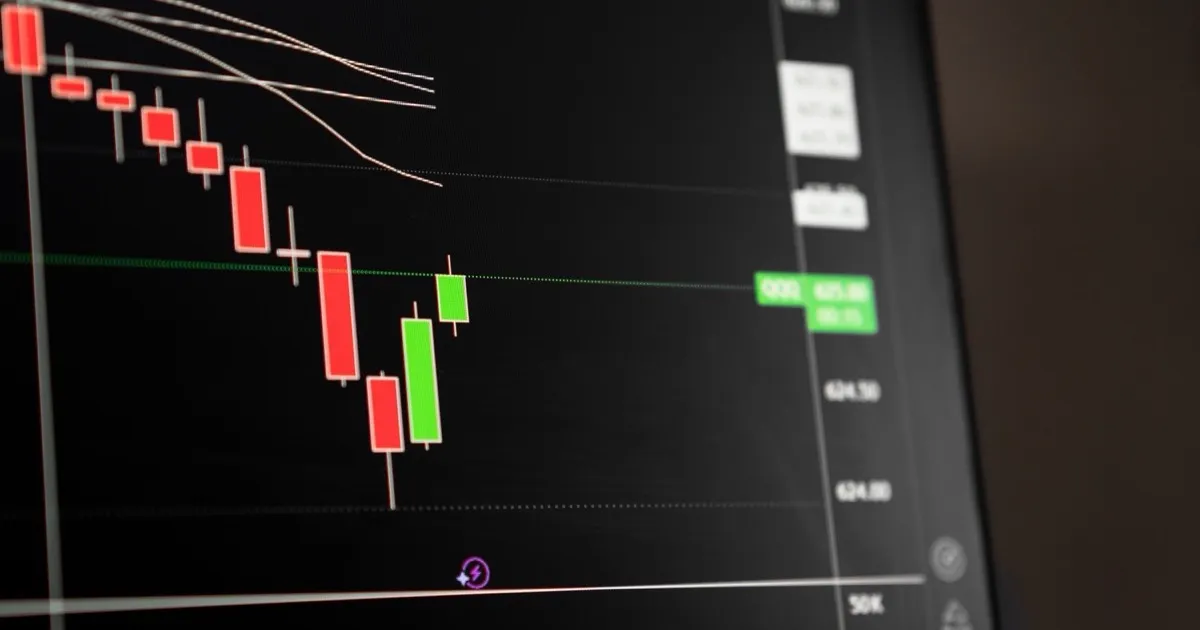
S&P 500 and Nasdaq Tumble as Warsh Fed Leaves Door Open to Rate Hikes

Wednesday began with a constructive setup and ended with a hawkish Fed repricing. The S&P 500 had room to extend the morning’s oil-relief trade, retail sales came in strong, and semiconductor equipment stocks initially helped the Nasdaq lean higher. Then Kevin Warsh’s first Federal Reserve decision as chair turned the question from “when do cuts return?” to “how real is the next hike risk?”
The Fed held the policy range at 3.50% to 3.75%, but the updated signal was not neutral. MarketWatch described the central bank as leaving the door open to rate hikes if inflation is not tamed, and live coverage showed rate-hike odds surging above 77% for December. Treasury yields moved sharply higher, the VIX jumped, and the late-day equity tape lost its footing.
The S&P 500 fell 1.21% to 7,420.10, the Nasdaq Composite lost 1.34% to 26,021.66 and the Dow dropped 507 points to 51,492.55. The selloff did not erase every pocket of strength: Moderna, Robinhood, GE Vernova and parts of the chip-equipment complex still worked. But after Tuesday’s split tape, Wednesday confirmed that the market will not tolerate rich growth multiples and a hawkish Fed message at the same time.
Closing Scoreboard
| Market | Close | Change | % Change |
|---|---|---|---|
| S&P 500 | 7,420.10 | −91.25 | −1.21% |
| Dow Jones Industrial Average | 51,492.55 | −507.12 | −0.98% |
| Nasdaq Composite | 26,021.66 | −354.69 | −1.34% |
| Russell 2000 | 2,917.98 | −21.21 | −0.72% |
| VIX | 18.44 | +2.03 | +12.37% |
| ICE U.S. Dollar Index | 99.57 | +0.03 | +0.03% |
| 10-Year Treasury Yield | 4.491% | +4.6 bps | — |
| 2-Year Treasury Yield | 4.203% | +14.9 bps | — |
| 2s/10s Spread | +28.8 bps | −10.3 bps | — |
| WTI Crude | $76.00 | −$0.05 | −0.07% |
| Brent Crude | $78.83 | −$0.72 | −0.91% |
| Gold | $4,283.60 | −$70.80 | −1.63% |
| EUR/USD | 1.1607 | −0.0003 | −0.03% |
| Bitcoin | $65,235 | −$370 | −0.56% |
What Happened
The morning setup was not bearish. Retail sales rose 0.9% in May, beating the 0.5% consensus and showing that consumers were still spending despite higher prices. Crude oil stabilized after Tuesday’s collapse, and the first half of the session favored semiconductor equipment, small caps and selected AI infrastructure names. Robinhood rallied on analyst target increases, and GE Vernova rose after Bernstein opened coverage with an Outperform rating.
The problem was timing. A strong retail-sales print is good for nominal growth, but it is not automatically good when the Fed is trying to prove inflation credibility. Warsh did not deliver an immediate hike message, and MarketWatch coverage said no one at the Fed pushed for an immediate move. Still, the policy statement and rate projections were enough to push the front end of the curve higher and pull the market away from the cut-friendly interpretation it wanted before 2 p.m.
By the close, investors were selling the parts of the market most exposed to higher discount rates: communication services, software, consumer discretionary, real estate and speculative SpaceX-linked trades. The Nasdaq fell less than the worst intraday prints suggested because chip-equipment names held some gains, but the broader market message was clear: the Warsh Fed has started by asking investors to reprice complacency.
The session also complicated the SpaceX narrative. The company’s post-IPO excitement is still a magnet for retail flows, but adjacent names no longer moved as one group. Robinhood benefited from trading-volume leverage and analyst support; EchoStar, which had been treated as a SpaceX-linked winner, sank as investors took profits and reduced exposure to speculative satellite and spectrum proxies.
Mega-Cap and Key Movers
| Ticker | Close | % Change | Session Driver |
|---|---|---|---|
| MRNA | $61.80 | +11.55% | FDA briefing documents ahead of Thursday’s flu-vaccine panel |
| HOOD | $105.20 | +8.78% | Analyst target hikes, record June trading volumes and workforce-cut discipline |
| GEV | $1,048.86 | +6.77% | Bernstein initiated coverage at Outperform with a $1,206 target |
| VRT | $317.58 | +6.00% | AI data-center power and cooling demand kept infrastructure names bid |
| WDC | $712.13 | +4.56% | AI storage momentum extended after recent analyst support |
| CVNA | $62.86 | −10.25% | CarMax margin warning pressured used-car retail peers |
| SATS | $111.70 | −7.66% | Profit-taking in SpaceX-linked satellite and spectrum exposure |
| EFX | $154.84 | −7.35% | Housing and credit-sensitive weakness after yields rose |
| APP | $479.49 | −6.93% | High-multiple ad-tech/software sold off with duration risk |
| NDAQ | $83.29 | −6.72% | Exchange operators hit by alternative-venue competition anxiety |
Top 3 Winners & Top 3 Losers
Top 3 Winners
MRNA — Moderna +11.55%, close $61.80.
Moderna rallied after FDA briefing documents ahead of Thursday’s Vaccines and Related Biological Products Advisory Committee meeting showed no major deficiencies for mFluSiva, its mRNA-based influenza vaccine. Benzinga reported that the primary efficacy analysis met all prespecified sequential success criteria versus the standard-dose comparator, while the FDA set an August 5 PDUFA date. Investors still have to weigh comparator and postmarketing-study questions, but the documents gave the market a credible near-term respiratory-vaccine catalyst.
HOOD — Robinhood Markets +8.78%, close $105.20.
Robinhood jumped as analysts rewarded both growth and cost discipline. Benzinga reported that Argus kept a Buy rating and raised its target to $110 from $90, while separate market coverage said Deutsche Bank raised its target to $105 from $98, citing record June trading volumes. The company also announced a roughly 10% workforce reduction, describing the move as an effort to stay lean while equities, options and prediction-market activity run at record month-to-date levels.
GEV — GE Vernova +6.77%, close $1,048.86.
GE Vernova gained after Bernstein initiated coverage with an Outperform rating and a $1,206 price target. The call landed into an already powerful AI power-and-grid narrative: data centers need electricity, interconnection capacity and grid upgrades, and GEV is now treated as one of the cleanest public-market ways to own that bottleneck. The stock also benefited from broader interest in infrastructure names after the market moved away from pure software exposure.
Top 3 Losers
CVNA — Carvana −10.25%, close $62.86.
Carvana fell after CarMax’s update sent a negative read-through across used-car retail. Benzinga reported that CarMax beat quarterly EPS expectations but warned that sales-margin pressure would persist, and the peer news dragged Carvana lower. The move was also rate-sensitive: a hawkish Fed and higher front-end yields make financing-sensitive consumer cyclicals harder to defend.
SATS — EchoStar −7.66%, close $111.70.
EchoStar sold off as the market unwound part of the SpaceX-linked satellite and spectrum trade. Recent Benzinga coverage had tied SATS rallies to SpaceX IPO enthusiasm and EchoStar’s meaningful SpaceX exposure, but Wednesday’s session showed a sharper distinction between direct trading-volume beneficiaries and speculative proxies. There was no clear single new company filing in the public pages fetched today; the decline looked like profit-taking and de-risking in a name that had already moved aggressively on SpaceX narratives.
EFX — Equifax −7.35%, close $154.84.
Equifax dropped in a housing-and-credit-sensitive selloff after yields rose and rate-cut hopes faded. The public sources fetched did not show a single fresh company-specific catalyst, so this reads as a macro and factor move rather than an earnings event. Weakness in housing-linked activity and a higher-for-longer Fed path both weigh on credit-bureau and verification businesses tied to hiring, lending and mortgage activity.
Sector Breakdown
| Sector ETF | Close | % Change | Read-Through |
|---|---|---|---|
| XLE Energy | $54.89 | −0.86% | Oil stabilized but energy equities kept repricing lower realizations |
| XLF Financials | $54.02 | −0.61% | Higher yields were offset by broader risk-off pressure |
| XLK Technology | $188.50 | +1.10% | Chip-equipment strength kept the sector positive despite software weakness |
| XLV Health Care | $150.71 | −1.46% | Moderna’s rally could not offset broader defensive weakness |
| XLI Industrials | $179.60 | −0.14% | GE Vernova helped, but late Fed selling clipped the group |
| XLP Staples | $83.68 | −2.23% | Defensives did not behave as a safe haven once yields rose |
| XLU Utilities | $44.46 | −1.33% | Bond-proxy pressure returned as the curve repriced higher |
| XLRE Real Estate | $43.97 | −2.51% | Rate-sensitive REITs lagged after the Fed opened the hike door |
| XLB Materials | $52.02 | −1.33% | Gold and copper weakness hit the commodity sleeve |
| XLC Communication Services | $109.20 | −2.78% | Worst major sector as internet, cable and satellite names sold off |
| XLY Consumer Discretionary | $115.49 | −2.51% | Amazon, Home Depot and Carvana kept pressure on consumer beta |
Global Markets
Overseas markets closed before the worst of the U.S. Fed reaction, so global indexes still looked relatively constructive. In Asia, Japan’s Nikkei 225 rose 0.72% to 69,902.25, Shanghai added 0.40% to 4,108.08 and Australia’s ASX 200 gained 0.54% to 8,966.3. Hong Kong lagged, with the Hang Seng down 0.74% to 24,312.16. South Korea and Singapore were stronger, with the KOSPI up 1.58% and the Straits Times up 1.16%.
Europe was also green. The STOXX Europe 600 rose 0.52% to 639.31, Germany’s DAX edged up 0.10% to 24,934.67 and the FTSE 100 added 0.14% to 10,508.61. Spain’s IBEX 35 gained 1.35%, while France’s CAC 40 slipped 0.20%. The European session was still mostly trading the oil-relief and lower-geopolitical-risk story, not the late U.S. yield shock.
Fixed Income and Commodities
The bond market was the day’s real transmission channel. The 10-year Treasury yield climbed to 4.491% at the latest MarketWatch quote, while the 2-year yield was listed near 4.203% in the related-bonds table. The front end moved harder than the long end, flattening the 2s/10s spread to roughly +29 basis points. That is a classic signal that investors are repricing policy risk more than long-run growth optimism.
Oil stabilized after Tuesday’s plunge. WTI front-month crude finished at $76.00, down 0.07%, while Brent settled at $78.83, down 0.91%. MarketWatch and Barron’s headlines framed the move around the release of U.S.-Iran deal text and the still-open question of whether shipping through Hormuz normalizes quickly. The level is much less inflationary than last week’s war premium, but the market is no longer treating lower oil as enough to offset a hawkish Fed.
Gold fell 1.63% to $4,283.60, which matters because it suggests Wednesday was not a classic safety bid. It was a real-rate and liquidity repricing. The dollar index rose modestly to 99.57, EUR/USD dipped to 1.1607 and Bitcoin eased to $65,235, leaving speculative assets on the defensive into the Thursday open.
Corporate News
The most important company-specific story was Robinhood. The stock rallied even as the broader market fell because investors saw the business as a direct beneficiary of the same speculative activity unsettling other parts of the tape. Record June trading volumes across equities, options and prediction markets gave analysts a reason to lift targets, and the 10% workforce reduction gave the move a margin-discipline angle rather than pure volume chasing.
GE Vernova and Vertiv kept the AI power theme alive. Bernstein’s initiation on GE Vernova with a $1,206 target reinforced the market’s belief that the AI buildout is not just about GPUs. It is about grid capacity, power generation, heat rejection and electrical infrastructure. Vertiv’s 6.00% rally fit the same playbook: investors still want infrastructure names with tangible demand visibility.
SpaceX remained a dominant undercurrent, but the trade fractured. Direct SpaceX enthusiasm and first-day options attention kept retail flows active, while EchoStar and some satellite proxies sold off. That split matters because it suggests investors are no longer buying every SpaceX-adjacent ticker indiscriminately after the Fed repricing.
Analyst Actions
Argus maintained a Buy rating on Robinhood and lifted its price forecast to $110 from $90. Benzinga’s broader midday market story also cited Deutsche Bank raising its Robinhood target to $105 from $98 on record June trading volumes and the workforce reduction. Bernstein initiated GE Vernova at Outperform with a $1,206 target and also started Constellation Energy at Outperform, keeping the AI-power trade in focus. On the chip-equipment side, Citi raised its Applied Materials target to $710 from $550, which helped AMAT close up 4.35% despite the late index weakness.
Economic Data
| Release | Actual | Consensus | Prior | Market Read |
|---|---|---|---|---|
| U.S. Retail Sales, May | +0.9% | +0.5% | +0.4% revised | Consumer demand stayed firm, complicating the rate-cut case |
| Retail Sales Ex Autos | Not posted in fetched calendar | +0.6% | +0.7% | Consensus pointed to broad strength before the release |
| Pending Home Sales, May | Not posted in fetched calendar | +1.0% | +1.4% | Housing remained rate-sensitive after the Fed repricing |
| Business Inventories, April | Not posted in fetched calendar | +0.5% | +0.9% | Secondary to retail sales and the FOMC decision |
| FOMC Decision | Hold at 3.50% to 3.75% | Hold | 3.50% to 3.75% | Statement left the door open to hikes if inflation persists |
The Census Bureau reported May retail and food-services sales of $763.7 billion, up 0.9% from April and up 6.9% from May 2025. Retail trade sales rose 1.0% from April, and nonstore retailers were up 12.2% from a year earlier. That is not a recessionary consumer tape, which is why the market struggled to pair the report with an imminent easing cycle.
The Fed decision was the macro event that mattered most. Warsh’s Fed held rates steady, but the market read the updated projections and public commentary as a move toward inflation credibility rather than immediate relief for risk assets. MarketWatch coverage noted that Warsh did not submit economic projections himself and said no one pushed for an immediate hike, but that did little to soothe a market focused on the door being open to future tightening.
After-Hours Movers
After-hours trading was active but did not produce a broad mega-cap earnings shock in the public quote snapshots. Several higher-volume extended-session names moved as traders digested the Fed decision and prepared for Thursday’s jobless-claims and Philadelphia Fed data.
| Ticker | After-Hours Price | After-Hours Move | Context |
|---|---|---|---|
| GS | $1,107.94 | +0.78% | Financials remained active after the Fed and yield move |
| NXE | $10.58 | +0.86% | Above-average after-hours volume in MarketWatch trending data |
| LILAK | $5.29 | +0.76% | Small positive extended-session move on active volume |
| TRLV | $9.16 | −3.04% | Weak after-hours quote in the MarketWatch trending list |
| FLZH | $3.32 | −13.77% | Thin but notable extended-session decline |
The AlphaEdge Take
Wednesday was a reminder that a strong economy can be bad for expensive equities when inflation credibility is the binding constraint. Retail sales beat, oil stayed below $80, and some AI infrastructure stocks still found buyers. But the Fed’s message overpowered those positives because it changed the rate path investors were using to justify duration risk.
The key level now is not just 7,500 on the S&P 500; it is the bond market’s tolerance for a Fed that is willing to discuss hikes. If the 2-year yield keeps moving higher, the market will keep punishing real estate, consumer discretionary, communications and high-multiple software. If yields stabilize Thursday, the tape can rotate rather than break.
We would not treat the selloff as a full risk-off liquidation yet. The presence of winners such as Moderna, Robinhood, GE Vernova, Vertiv and Western Digital shows that investors are still paying for verified catalysts and real demand. What disappeared Wednesday was the willingness to buy every speculative or high-duration story just because oil stopped rising.
Bottom line: Warsh’s first Fed day narrowed the market’s margin for error. Bulls need Thursday’s data and Treasury trading to calm down quickly; otherwise, the Nasdaq’s reset can pull the S&P 500 toward the lower end of last week’s range even with oil back below $80.
Senior Equity Analyst & Founder at AlphaEdge. Columbia University MSFE (2011–2013). Covering equities, macro, and geopolitics for serious investors.