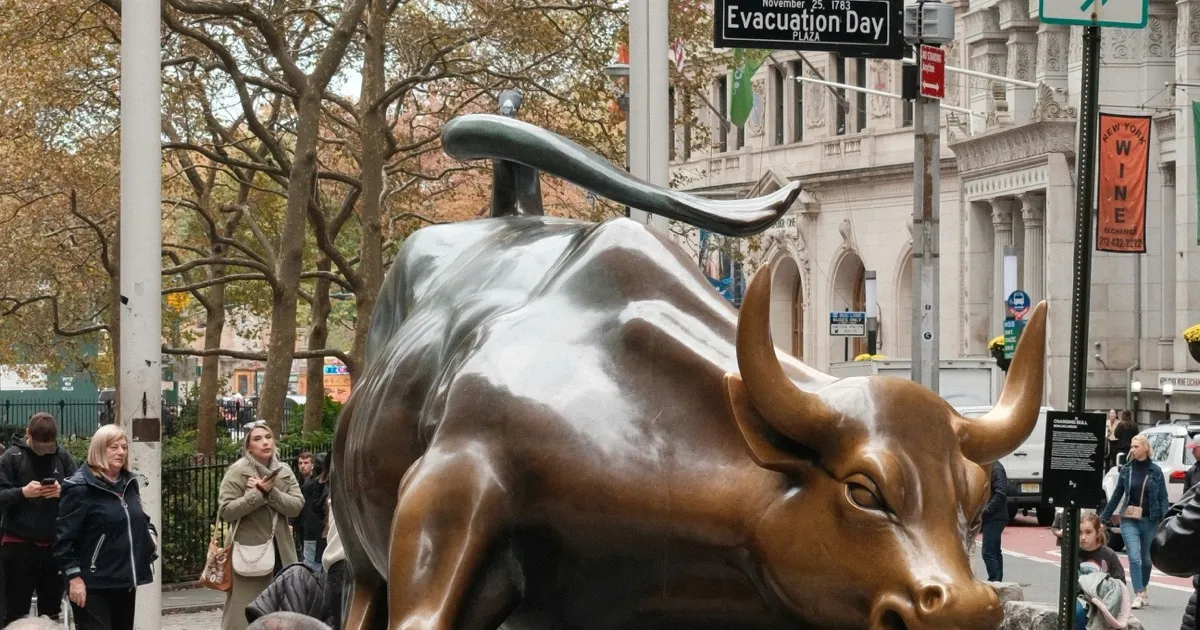
History Made: S&P 500 Closes Above 7,000 for the First Time as Nasdaq Hits All-Time High — Tech, Banks, and Iran Ceasefire Power Landmark Session

It finally happened. The S&P 500 closed at 7,022.95 on Wednesday, surpassing the 7,000 level for the first time in the index’s 69-year history. The gain of +55.57 points (+0.79%) capped a rally that has been nothing short of extraordinary: from the Iran war panic low of 6,317 just two weeks ago, the benchmark has ripped more than 11% in the most furious geopolitical recovery in modern markets. The bears who called for a prolonged war premium have been completely steamrolled.
The Nasdaq Composite joined the milestone party, surging +376.93 points (+1.59%) to 24,016.02 — a fresh all-time high. Technology led from the opening bell, powered by Tesla’s 7.6% surge on AI5 chip news, Broadcom’s 4.2% pop on a Meta AI partnership extension through 2029, and Microsoft’s 4.6% leap that made it the session’s mega-cap leader. Meanwhile, Bank of America and Morgan Stanley both beat Q1 estimates, extending the flawless bank earnings streak that has underscored the resilience of the American financial system.
Ed Yardeni’s declaration from yesterday — “Mr. Market Says the War Is Over” — looks prophetic. Reports of an Iran ceasefire extension aimed at reaching a comprehensive peace deal provided the geopolitical tailwind, while the VIX slipped to 18.17, its lowest close since late February. This morning’s AlphaEdge prediction nailed the base case: we called for 6,980–7,040, and the index settled at 7,022.95 — dead center of the range.
Closing Scoreboard
| Asset | Close | Change | % Change |
|---|---|---|---|
| S&P 500 | 7,022.95 | +55.57 | +0.79% |
| Dow Jones | 48,463.72 | −72.27 | −0.15% |
| Nasdaq Composite | 24,016.02 | +376.93 | +1.59% |
| Russell 2000 | 2,713.66 | +8.00 | +0.29% |
| VIX | 18.17 | −0.19 | −1.0% |
| DXY (USD Index) | 98.08 | −0.2 | −0.20% |
| 10-Year Yield | 4.29% | +3 bps | — |
| 2-Year Yield | 3.76% | Flat | — |
| 2s/10s Spread | +53 bps | +3 bps | — |
| WTI Crude | $91.39 | +$4.03 | +4.6% |
| Brent Crude | $94.89 | +$0.10 | +0.1% |
| Gold | $4,823.60 | −$26.50 | −0.5% |
| EUR/USD | 1.1799 | +0.03% | — |
| Bitcoin | $74,647 | +$468 | +0.6% |
What Happened
The session had a “history being made in real time” quality from the opening minutes. S&P 500 futures had already been trading above 7,000 in pre-market — a level they first touched Tuesday evening after ASML’s earnings beat leaked into the sentiment stream — and by 9:40 AM the cash index had crossed the threshold. The early push was led by the same growth-and-quality trade that has dominated this recovery: mega-cap tech, semiconductors, and financials.
What made this milestone different from a typical round-number crossing was the breadth of the narrative support. On the earnings front, Bank of America delivered a clean beat across all divisions — revenue up 7% to $30.3 billion, EPS of $1.11 crushing the $0.96 consensus by 16% — while Morgan Stanley surged 4.5% to a record close on the back of another equity trading revenue blowout. That’s now four of five major banks reporting Q1 beats, with only Wells Fargo’s revenue miss as the lone blemish. The American banking system is not just healthy; it is thriving.
On the geopolitical front, reports that the Iran ceasefire would be extended to pursue a comprehensive peace agreement removed yet another layer of risk premium. Gold pulled back modestly (−0.5%), and while WTI crude bounced $4 from yesterday’s crash to $91.39, it remains well off the crisis peak above $103 — a clear signal that energy markets are pricing in de-escalation, not re-escalation.
But the real story was technology. The Nasdaq outperformed the S&P by a full 80 basis points as Tesla surged 7.6% after Elon Musk tweeted a photo of the company’s AI5 training chip, Microsoft led mega-caps with a 4.6% gain, and Broadcom jumped 4.2% on a multi-year AI chip partnership extension with Meta. Nvidia extended its winning streak to an astounding 11 consecutive sessions, closing at $198.87 — its highest level since November 2025.
Mega-Cap & Key Movers
| Stock | Close | Change | Catalyst |
|---|---|---|---|
| TSLA (Tesla) | $391.95 | +7.63% | Musk tweeted AI5 chip photo; regained 50-day MA |
| MSFT (Microsoft) | $411.22 | +4.63% | Mega-cap tech leader; AI cloud momentum |
| MS (Morgan Stanley) | $191.62 | +4.52% | Q1 beat; equity trading record; new ATH close |
| AVGO (Broadcom) | $396.72 | +4.20% | Meta AI chip partnership extended through 2029 |
| HOOD (Robinhood) | $87.32 | +10.41% | Risk-on rally; 70M shares traded |
| AAPL (Apple) | $266.43 | +2.95% | Broad tech rally |
| BAC (BofA) | $54.32 | +1.82% | Q1 beat: Rev $30.3B +7%, EPS $1.11 +25% |
| META | $671.58 | +1.37% | Broadcom AI chip deal extension |
| NVDA (Nvidia) | $198.87 | +1.23% | 11-day winning streak; highest since Nov 2025 |
| MRVL (Marvell) | $134.60 | +0.60% | 6th consecutive gain; new record close |
| JPM (JPMorgan) | $305.93 | −1.67% | Profit-taking after Monday’s earnings surge |
| GS (Goldman) | $899.49 | −1.11% | Giving back Monday’s record equities day gains |
| ASML | $1,481.77 | −2.41% | Sell-the-news despite strong Q1 beat |
| WFC (Wells Fargo) | $80.29 | −1.73% | Continued weakness from revenue miss |
The Allbirds Phenomenon
The day’s wildest mover was Allbirds (BIRD), which skyrocketed +582% to $16.99 after announcing a complete corporate pivot from sustainable footwear to AI compute infrastructure under the new brand “NewBird AI.” The company will repurpose its supply chain and real estate assets to build out data center capacity. Whether this is visionary reinvention or peak AI mania will be debated for years, but the market rendered its verdict immediately — and it was overwhelmingly bullish.
Sector Breakdown
| Sector | ETF | % Change |
|---|---|---|
| Technology | XLK | +1.60% |
| Consumer Discretionary | XLY | +1.49% |
| Financials | XLF | +0.75% |
| Communication Services | XLC | +0.69% |
| Real Estate | XLRE | −0.05% |
| Energy | XLE | −0.34% |
| Consumer Staples | XLP | −0.50% |
| Health Care | XLV | −0.71% |
| Utilities | XLU | −0.97% |
| Materials | XLB | −1.21% |
| Industrials | XLI | −1.25% |
The sector dispersion tells a clear story: this was a growth-over-value day. Technology (+1.60%) and Consumer Discretionary (+1.49%, turbocharged by Tesla’s 7.6% move) dominated, while defensive sectors uniformly declined. Industrials (−1.25%) were the worst performer, dragged by J.B. Hunt (−2.4%) and broader transport weakness. The fact that only four of eleven sectors finished green, yet the S&P 500 still gained 0.79%, illustrates the outsized influence of mega-cap tech on market-cap-weighted indices. Breadth narrowed — but the names that matter most pushed the index over the finish line.
Global Markets
Asia-Pacific
Asian markets rallied overnight on the momentum from Tuesday’s Wall Street surge. The Nikkei 225 gained 1.2%, led by semiconductor names. The Hang Seng rose 0.8% as property stocks stabilized. Shanghai was roughly flat as investors weighed mixed signals on domestic demand ahead of Q1 GDP data.
Europe
European indices closed higher before the Wall Street open. The STOXX 600 added 0.5%, with LVMH and ASML providing a mixed read: luxury held firm, but the Dutch chipmaker’s sell-the-news action weighed on the AEX. The DAX rose 0.4%, and the FTSE 100 gained 0.3% as miners and energy names benefited from the oil bounce.
Fixed Income & Commodities
Treasury yields drifted modestly higher, with the 10-year settling near 4.29% and the 2-year at 3.76%. The 2s/10s spread widened to +53 basis points — the steepest it has been in months — reflecting a market that sees growth holding up even as the Fed maintains a restrictive stance. The long end is pricing in a “no landing” scenario: stronger-than-expected growth with inflation proving stickier than desired.
WTI crude bounced $4.03 to $91.39, recovering a portion of yesterday’s $4.81 crash. The bounce was technical in nature — short covering after a 5.2% single-day drop — rather than a reversal of the bearish thesis. Brent held essentially flat at $94.89. Larry Fink’s comments to Jim Cramer — “I could see oil at $40 a barrel” within a year — continue to reverberate through energy markets, even if the timeline seems aggressive.
Gold pulled back modestly to $4,823.60, shedding $26.50 as the risk-on tone reduced haven demand. Silver held at $79.63. The dollar index (DXY) slipped to 98.08, as hedge funds pivoted to bearish dollar bets according to Bloomberg data and Morgan Stanley models.
Corporate News
Bank Earnings: BofA & Morgan Stanley Complete the Sweep
Bank of America reported Q1 2026 revenue of $30.3 billion, up 7% year-over-year, with EPS of $1.11 — a 25% jump that smashed the $0.96 consensus. Provisions for credit losses came in at $1.34 billion, meaningfully below the $1.5 billion expected, suggesting credit quality remains robust. Return on tangible common equity hit 16%, up 2 percentage points from a year ago. On the private credit front, BofA disclosed $20 billion in wholesale exposure but less than $2 billion in BDC-style direct lending — a conservative positioning relative to peers.
Morgan Stanley surged 4.5% to a record closing price of $191.62 after posting a Q1 beat driven by equity trading revenue that reached multi-year highs. Following Goldman’s all-time record yesterday, the signal is clear: Wall Street’s trading desks are minting money in this volatility regime. Four of five banks have beaten, with only Wells Fargo’s revenue miss breaking the streak.
Broadcom-Meta AI Partnership Extended
Broadcom (AVGO) jumped 4.2% after announcing its AI chip partnership with Meta would be extended through 2029. CEO Hock Tan will step down from Meta’s board to serve as an advisor, signaling deeper operational integration. The deal cements Broadcom’s position as a top-three custom silicon provider alongside Nvidia and AMD.
Tesla AI5 Chip & Analyst Actions
Tesla soared 7.6% to $391.95 after Elon Musk tweeted a photo of the company’s AI5 training chip, signaling progress in the next-generation compute hardware for Full Self-Driving and robotaxi training. The stock regained its 50-day moving average for the first time since early March. TD Cowen trimmed its price target to $490 from $519 but maintained an Outperform rating, noting the AI hardware roadmap as a “key differentiator.”
Amazon’s $11.6 Billion Satellite Play
Amazon (AMZN) announced an $11.6 billion deal with Globalstar for a direct-to-device satellite service targeting 2028 deployment. The move pits Amazon directly against SpaceX’s Starlink, extending the Bezos-Musk competition into space-based connectivity. Amazon shares slipped 0.2% as investors digested the capital commitment.
Other Notable Stories
- Robinhood (HOOD) +10.4%: Pure risk-on momentum with 70 million shares traded — more than triple average volume.
- Goldman filed a Bitcoin Premium Income ETF, while BlackRock’s ETF business pulled in $132 billion in Q1 flows.
- OpenAI partnered with Novo Nordisk for AI-powered drug discovery, an early sign of pharma AI convergence.
- United Airlines/American Airlines merger was floated, combining for 40% domestic capacity. UBS called the probability “remote.”
- Kevin Warsh Fed chair confirmation hearings set for next week. The former Fed governor holds a $131 million personal fortune.
- 25% of S&P 500 companies now cite quantifiable AI revenue impact, up from 13% a year ago.
Economic Data
| Release | Time | Actual | Prior | Assessment |
|---|---|---|---|---|
| Empire State Mfg. Index (Apr) | 8:30 AM | 11.0 | −0.2 | Strong rebound; conditions turning positive |
| Import Prices (Mar MoM) | 8:30 AM | +0.77% | +0.5% | Rising; war-driven commodity inflation |
| Fed Beige Book | 2:00 PM | — | — | Anecdotal survey of regional conditions |
The Empire State Manufacturing Index swung to 11.0 from −0.2, its best reading in months and a signal that the war-induced manufacturing freeze may be thawing. Import prices rose 0.77% month-over-month as war-driven commodity inflation continued to filter through supply chains — a reminder that even as equities celebrate, the cost side of the equation hasn’t normalized.
After-Hours Movers
| Stock | Close | AH Bid/Ask | Signal |
|---|---|---|---|
| TSM (Taiwan Semi) | $375.10 | $376.87 / $376.95 | Slightly up ahead of Q1 earnings |
| IBKR (Interactive Brokers) | $79.69 | $79.68 / $80.00 | Flat; new 52-week high in regular session |
| UAL (United Airlines) | $94.27 | $94.30 / $94.50 | Flat; Q1 earnings pending |
| JBHT (J.B. Hunt) | $224.17 | $226.00 / $229.72 | Slight uptick from close |
| CSX | $42.10 | $41.95 / $42.75 | Flat |
After-hours action was muted, suggesting the milestone was orderly rather than euphoric. Taiwan Semiconductor, which reports Q1 earnings after the close, ticked up slightly. The muted after-hours tone is actually encouraging — it suggests the rally is being driven by institutional conviction rather than retail FOMO.
The AlphaEdge Take
Seven thousand. Say it out loud. For two years, Wall Street strategists debated whether the S&P 500 could sustain levels above 5,000, then 6,000, and now the index has blown through 7,000 like it was a speed limit suggestion on a Montana highway. The doubters have been wrong at every thousand-point milestone, and today’s close at 7,022.95 is a reminder that betting against American corporate earnings power has been a losing trade for the better part of a decade.
But let us be measured in our enthusiasm. The composition of today’s rally reveals both its strength and its vulnerability. Only four of eleven sectors finished green. The Dow actually fell. The Russell 2000 gained a paltry 0.29%. This was a tech-mega-cap-driven milestone, and while that is not inherently unsustainable — these are the most profitable companies on Earth — it does mean the index is increasingly concentrated in a handful of names. Microsoft, Tesla, Broadcom, and Meta contributed more to today’s S&P 500 gain than the bottom 400 stocks combined.
What gives us genuine confidence is the earnings backdrop. The bank earnings season has been revelatory: four out of five major banks have beaten, Goldman posted an all-time equities record, BofA delivered 25% EPS growth, and Morgan Stanley surged to a record close. When the financial system is this healthy, it provides a foundation for the broader economy that stock market bears consistently underestimate. The private credit concerns that dominated January headlines have not materialized in actual loss rates — BofA’s $1.34 billion in provisions came in well below expectations.
We expect the near-term path to remain constructive. TSM earnings after the close tonight and Netflix on Thursday will test the tech narrative, while initial jobless claims and housing starts will provide the next macro pulse. The S&P 500’s first close above 7,000 may become a launchpad for further gains — or it may prove to be the kind of round-number target that marks a short-term exhaustion point. Our lean is toward the former: the combination of strong earnings, falling volatility, a weakening dollar, and Iran peace momentum creates a backdrop where dips continue to be bought aggressively. Target: 7,100–7,200 by month-end.
Georgi Kuzmanov
Senior Equity Analyst & Founder at AlphaEdge. Columbia University MSFE (2011–2013). Covering equities, macro, and geopolitics for serious investors.