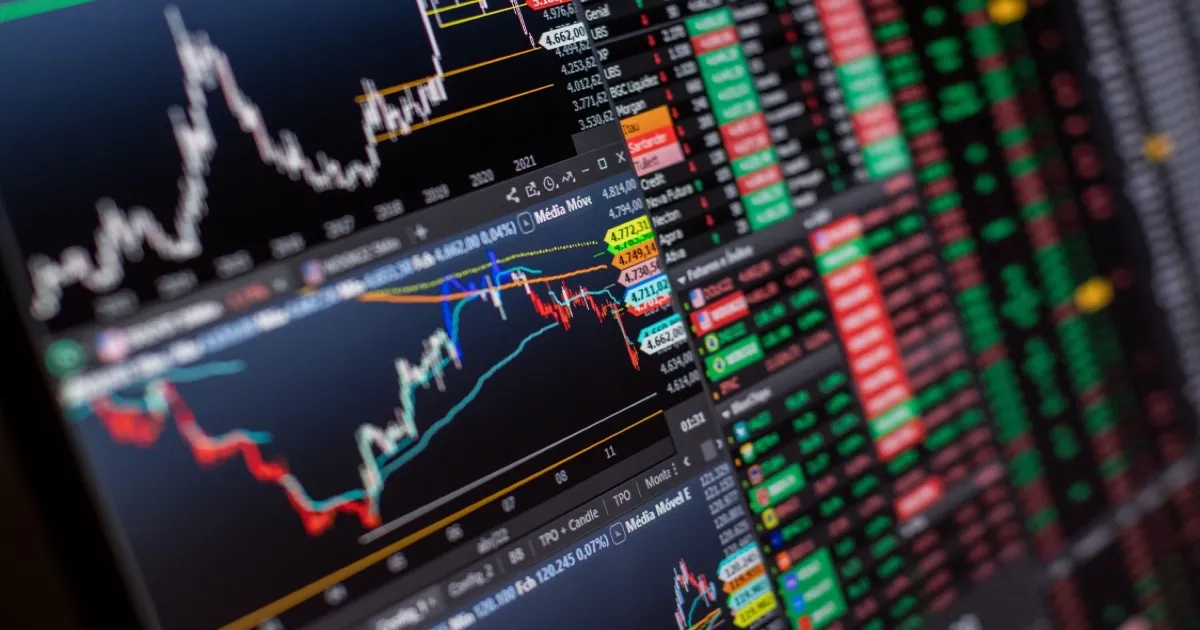
Nasdaq Plunges as Hot Payrolls and Chip Selling Crush the AI Trade

Friday turned Thursday's elegant rotation into a harder valuation test. The May payrolls report landed at 172,000 jobs, more than double the 80,000 consensus that markets had been bracing for in the morning, and the rate tape immediately tightened around the message: the Fed did not get the labor-market weakness it needed to justify quick easing. By the close, the Nasdaq Composite was down 1,121.526 points, or 4.18%, to 25,709.432, its worst session since April 2025 according to CNBC's market banner.
The damage was not isolated to one earnings miss. Micron, Teradyne, First Solar, SanDisk and Intel all fell more than 11% on CNBC's market-movers board, while Broadcom and Meta remained pressure points in the broader AI-capex debate. The S&P 500 lost 200.57 points, or 2.64%, to 7,383.74, the Russell 2000 dropped 3.47%, and the Dow gave back 695.15 points after Thursday's record close.
What made the session so sharp was the collision of two trades. Investors had spent Thursday buying health care, banks and small caps as a sign that the market could broaden away from mega-cap technology. On Friday, a stronger payrolls report pushed the 2-year yield up 10.8 basis points to 4.157%, the 10-year yield up 6.5 basis points to 4.542%, and the VIX up 39.68% to 21.51. Rotation did not vanish, but the higher-rate shock made the expensive AI side of the tape pay for its crowding.
Closing Scoreboard
| Instrument | Close | Change | Read-through |
|---|---|---|---|
| S&P 500 | 7,383.74 | −200.57 / −2.64% | Broad selloff after hot payrolls |
| Dow Jones Industrial Average | 50,866.78 | −695.15 / −1.35% | Record-close reversal from Thursday |
| Nasdaq Composite | 25,709.432 | −1,121.526 / −4.18% | AI and chip selling led the tape lower |
| Russell 2000 | 2,833.501 | −101.826 / −3.47% | Small caps hit by higher yields |
| VIX | 21.51 | +6.11 / +39.68% | Volatility surged back above 20 |
| DXY Dollar Index | 100.094 | +0.681 / +0.69% | Dollar rallied with Treasury yields |
| 10-Year Treasury Yield | 4.542% | +6.5 bps | Back above the 4.50% pressure zone |
| 2-Year Treasury Yield | 4.157% | +10.8 bps | Front end repriced Fed-cut risk |
| 2s/10s Spread | +38.5 bps | flatter | Front-end yields rose faster than long yields |
| WTI Crude | $90.30 | −2.74 / −2.94% | Oil fell despite rate-driven risk-off |
| Brent Crude | $92.55 | −2.48 / −2.61% | Energy risk premium cooled |
| Gold | $4,337.70 | −167.30 / −3.71% | Dollar and real-yield pressure hit metals |
| EUR/USD | 1.1520 | −0.009 / −0.78% | Euro weakened against a stronger dollar |
| Bitcoin | $60,850 | −2,716.50 / −4.27% | Crypto beta cracked with risk assets |
What Happened
The payrolls print changed the conversation before the opening bell. CNBC reported that May nonfarm payrolls rose 172,000, with sharp upward revisions to prior months, and that traders pushed the probability of a Fed hike by year-end 2026 to roughly 70% around midday, according to CME FedWatch pricing. That is the opposite of the soft-landing narrative equity bulls wanted after Thursday's cooler labor-cost data.
The immediate casualty was duration-sensitive growth. Higher front-end yields made long-duration AI cash flows less forgiving, and the market sold the parts of the technology complex that had already priced in years of flawless demand. Broadcom's post-earnings pressure continued, Micron and SanDisk were hit by memory-profit-taking, Teradyne sold off with semiconductor-test exposure, and Intel fell as the entire chip complex repriced from momentum to risk control.
The second casualty was the idea that Thursday's broadening trade could insulate everything outside technology. Health care and staples did cushion parts of the index, but the Russell 2000 still fell 3.47% because higher yields are not friendly to smaller balance sheets. Financials also lost support as the curve flattened: the 2-year yield rose more than the 10-year, a signal that markets were repricing Fed policy more than growth optimism.
Friday was not a recession tape. Oil fell, gold fell, and the dollar rallied, which is more consistent with a policy-rate shock than a classic flight-to-safety session. The message was narrower and more actionable: when payrolls are hot, inflation is still elevated, and AI capex is increasingly funded through large equity raises or expensive capacity deals, the market demands a lower multiple for anything priced as a sure thing.
Mega-Cap and Key Movers
| Ticker | Company | Close | Change | Driver |
|---|---|---|---|---|
| META | Meta Platforms | $593.00 | −5.51% | FT report on potential AI-funding equity raise |
| AVGO | Broadcom | $418.91 | −12.59% | AI expectations reset after earnings |
| MU | Micron Technology | $864.01 | −13.25% | Memory names hit by Broadcom read-through |
| TER | Teradyne | $357.93 | −12.03% | Semiconductor-test exposure sold off |
| FSLR | First Solar | $279.01 | −11.41% | High-beta clean-energy winner unwound |
| INTC | Intel | $99.17 | −11.28% | Chip complex pressure and AI-positioning reset |
| KMB | Kimberly-Clark | $99.04 | +6.28% | Defensive staples and ex-dividend support |
| CLX | Clorox | $94.14 | +5.03% | Low-beta staples bid |
| KVUE | Kenvue | $17.71 | +4.92% | Consumer-health defensiveness |
| LULU | Lululemon | $124.92 | −0.88% | Post-close guide-down became after-hours focus |
Top 3 Winners & Top 3 Losers
CNBC's U.S. market-movers page captured the shape of the day: the winners were defensive, dividend or health-care names; the losers were concentrated in semiconductors, AI infrastructure and high-beta growth.
Top 3 Winners
COO — Cooper Companies +8.58% close $67.34
Cooper Companies topped CNBC's gainer list at $67.34, up 8.58%. The medical-device name had already reported Q2 EPS of $1.21, and Friday's move was mostly a defensive health-care bid in a tape where investors wanted lower-beta earnings away from AI hardware. The stock's 8.76 million-share volume showed that the move was more than a quiet defensive drift.
FDXF — FedEx Freight Holding +6.42% close $167.84
FedEx Freight Holding rose 6.42% to $167.84, ranking second on CNBC's market-movers board. The move looked flow-driven rather than tied to a single fresh company announcement: transports and industrial services held up as investors searched for earnings exposure less directly tied to AI multiple compression. In a day defined by rate shock, the outperformance was notable because cyclicals usually struggle when small caps sell off this hard.
KMB — Kimberly-Clark +6.28% close $99.04
Kimberly-Clark gained 6.28% to $99.04 as staples became one of the few places investors were willing to pay up. CNBC showed the stock was ex-dividend Friday and carried a 5.17% dividend yield in key stats. That combination made the stock a natural refuge as investors reduced exposure to expensive growth and looked for cash-flow durability.
Top 3 Losers
MU — Micron Technology −13.25% close $864.01
Micron was the biggest decliner on CNBC's market-movers list, down 13.25%. The catalyst was not one isolated Micron filing; it was the market's decision to sell memory winners after Broadcom's outlook and rising-rate shock challenged the AI supply-chain trade. The stock had been one of the year's strongest performers, so the move reflected both profit-taking and a sharper risk premium for AI-linked cyclicality.
TER — Teradyne −12.03% close $357.93
Teradyne fell 12.03% as investors dumped semiconductor-test exposure alongside the broader chip complex. The company did not need a company-specific earnings miss to sell off; its problem was linkage to a trade that had become crowded and highly sensitive to discount rates. When the 2-year yield jumped 10.8 basis points, test-equipment multiples had little room for patience.
FSLR — First Solar −11.41% close $279.01
First Solar dropped 11.41% to $279.01. Higher yields were the obvious headwind because clean-energy projects are rate-sensitive, and the stock had recently traded near a 52-week high. Friday's decline was therefore a valuation and positioning reset, not a single-event fundamental break. The important read-through is that the market punished high-beta winners even outside classic semiconductors.
Sector Breakdown
| Sector | Level | Move | Read-through |
|---|---|---|---|
| Health Care | 1,768.33 | +3.16% | Defensive leadership and medical-device strength |
| Financials | 866.74 | +2.68% | Banks held up before curve flattening worsened |
| Communication Services | 481.84 | +2.12% | Sector-level strength masked Meta weakness |
| Real Estate | 281.35 | +2.07% | Rate-sensitive group outperformed on earlier rotation |
| Industrials | 1,488.26 | +1.24% | Selective cyclical demand remained |
| Utilities | 444.74 | +0.61% | Defensive yield proxy held up |
| Consumer Discretionary | 1,925.74 | +0.52% | Mixed session before Lululemon guide-down |
| Energy | 891.77 | +0.02% | Flat despite lower crude |
| Materials | 644.17 | +0.01% | Barely positive as cyclicals faded |
| Consumer Staples | 915.18 | −0.06% | Mixed index, but KMB, CLX and KVUE led individual gainers |
| Technology | 7,048.99 | −1.43% | AI and semiconductor pressure dominated |
The sector data requires a little nuance. CNBC's sector-watch table showed health care, financials, communication services and real estate higher, even as the headline Nasdaq and S&P 500 were hit hard. That divergence tells us the selling was concentrated in the most crowded and most valuation-sensitive pockets. The problem for index investors is that those pockets still carry enormous weight.
Global Markets
Global equities were already soft before the U.S. payroll shock. CNBC's Friday live coverage reported that South Korea led Asia lower as technology weakness spread across the region. The Kospi ended down 5.54% at 8,160.59, with Samsung Electronics off 6.40% and SK Hynix down 9.92%. Japan's Nikkei 225 fell 1.31% to 66,588.12, Australia's ASX 200 lost 0.70% to 8,625.10, Hong Kong's Hang Seng was down 1.11% late in its session, and mainland China's CSI 300 fell 1.79% to 4,816.92.
The international read-through was important because the U.S. selloff was not purely domestic. AI-linked equity pressure had already moved into Korean memory and Japanese technology names before the May payrolls data hit. Once U.S. yields jumped after 8:30 a.m. ET, global tech weakness and domestic Fed repricing became the same trade.
Fixed Income and Commodities
The bond market was the session's engine. The 2-year yield rose to 4.157%, up 10.8 basis points, while the 10-year rose to 4.542%, up 6.5 basis points. That flattened the 2s/10s spread to roughly 38.5 basis points and told investors that the front end was repricing Fed policy faster than the long end was repricing growth.
CNBC's Fed analysis said the strong jobs report swept aside the possibility of cuts anytime soon, and quoted PNC chief economist Gus Faucher arguing that with job growth good and inflation high, the Fed can keep rates where they are until it gets a better inflation picture. That framing matched the price action: growth stocks fell, the dollar rose, and the VIX jumped.
Commodities did not behave like a geopolitical panic. WTI crude fell to $90.30 and Brent to roughly $92.55, while gold dropped 3.71% to $4,337.70. The dollar index rose to 100.094 and EUR/USD slipped to 1.1520. Bitcoin broke below $60,000 intraday, with CNBC reporting a low near $59,099.25 and a last quote of $60,850 at 4:23 p.m. ET, down 4.27%.
Corporate News
Meta became the cleanest corporate expression of AI-funding anxiety. CNBC reported that Meta shares dropped more than 5% after the Financial Times said the company could raise tens of billions of dollars through a stock offering to fund AI investments. The company called the report speculation, but investors focused on the broader question: how much equity and debt will be required to fund the next leg of AI infrastructure?
That question became sharper because Alphabet had already discussed a much larger equity raise and CNBC also reported that Google would pay SpaceX $920 million a month for compute capacity at xAI data centers. The number is less important than the message. AI demand may be enormous, but the financing burden is becoming visible, and Friday's higher-rate environment made that burden more expensive.
Lululemon was the post-close consumer warning. The stock fell 10.60% after hours to $111.67 after the company cut its annual outlook and issued weak Q2 guidance. CNBC and TipRanks reported Q2 EPS guidance of $1.76 to $1.81 versus a $2.69 consensus, and fiscal-year EPS guidance of $10.95 to $11.15 versus $12.28 expected. That keeps the consumer-discretionary story fragile heading into Monday.
Economic Data
| Release | Actual | Consensus / Prior | Market reaction |
|---|---|---|---|
| May nonfarm payrolls | +172,000 | +80,000 expected | Fed-cut hopes faded; yields jumped |
| Unemployment rate | 4.3% | 4.3% expected | Labor market did not weaken enough for cuts |
| CME FedWatch read-through | Hike odds near 70% by end-2026 | CNBC midday read | Front-end rates repriced sharply |
| Consumer credit, 3:00 p.m. ET | Pending in MarketWatch calendar | $10.0 billion prior | Secondary to payrolls |
The jobs report did not just beat; it beat the specific market setup. Friday morning's article framed the day around an 80,000 consensus and a 4.3% unemployment rate. A print of 172,000 jobs left little room for the soft-labor, lower-yield interpretation that supported Thursday's rotation. That is why the 2-year yield mattered more than the headline equity level: the market was repricing policy first and equities second.
After-Hours Movers
| Ticker | After-Hours Price | Move | Note |
|---|---|---|---|
| LULU | $111.67 | −10.60% | Cut annual and Q2 guidance despite Q1 beat |
| META | $589.73 | −0.55% | AI-funding concern persisted after the close |
| INTC | $98.61 | −0.56% | Chip pressure extended modestly |
| TER | $355.00 | −0.82% | Semiconductor-test weakness continued |
| FSLR | $276.10 | −1.04% | Rate-sensitive clean energy stayed heavy |
| AVGO | $418.40 | −0.12% | Broadcom stabilized but did not bounce |
The after-hours tape did not repair the damage. Lululemon's guidance shock put a consumer-pressure story on top of the rate and AI stories, while Meta and the chip names continued to trade heavy. That matters for Monday because the market will need more than a technical bounce; it will need evidence that Friday's derating has not spread into forward earnings expectations.
The AlphaEdge Take
Friday was a valuation reset disguised as a macro shock. The jobs number caused the move, but the scale of the Nasdaq decline came from positioning. AI hardware, memory, test equipment and AI-funded megacap spending had been priced for near-perfect demand. A hot payrolls report and a jump in front-end yields made investors ask whether those cash flows deserve lower multiples.
The good news is that the market still has places to hide. Cooper Companies, Kimberly-Clark, Clorox and Kenvue did not rally because the economy is booming; they rallied because investors wanted defensiveness with less AI sensitivity. That is a healthier response than a pure liquidation day. The bad news is that the S&P 500 cannot ignore a 4.18% Nasdaq decline when technology remains the index's gravity center.
Monday's test is therefore simple. The S&P 500 needs to reclaim the 7,420 to 7,450 zone quickly, the 10-year yield needs to settle back below 4.50%, and the VIX needs to cool below 20. Without those three conditions, rallies in chip stocks should be treated as oversold bounces rather than proof that the AI trade has fully reset.
Bottom line: stay defensive and selective into Monday. The broad bull case is not dead, but Friday showed that hot labor data plus expensive AI expectations can erase weeks of momentum in one session; favor health care, staples and cash-generative quality while waiting for the Nasdaq to prove it can stabilize above 25,700 without another jump in yields.
Senior Equity Analyst & Founder at AlphaEdge. Columbia University MSFE (2011–2013). Covering equities, macro, and geopolitics for serious investors.