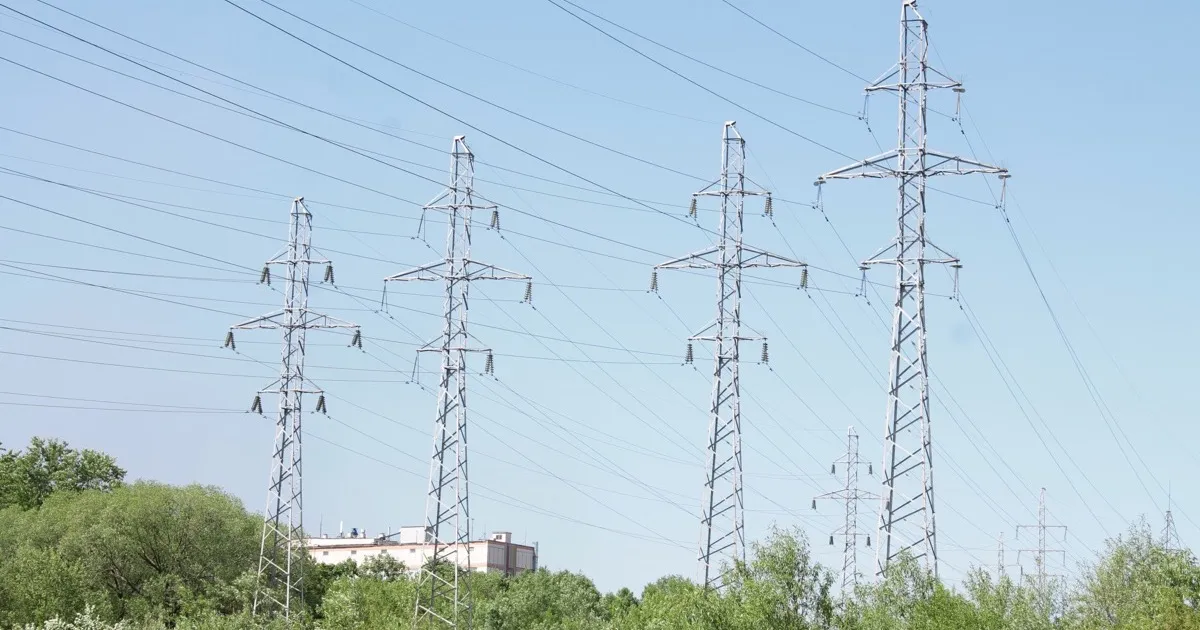
Electricity, Not Silicon, Is the AI Bottleneck. How the Power Trade Rotated From Generators to the Grid

For twenty years the smartest thing you could say about American electricity demand was that it wasn’t growing. Efficiency gains offset population and GDP, and the grid coasted. That era is over. US power demand is now rising for the fourth straight year — the first such run since 2007 — and the reason is the same one driving three of our recent deep dives: the artificial-intelligence build-out. But the most important development in the electricity trade this year is not that demand is booming. It is that the market has quietly changed its mind about which part of the electricity supply chain is scarce — and the rotation has been violent.
The Catalyst
Two data points from the past few weeks frame the moment. In late July, GE Vernova — the turbine-and-grid company spun out of General Electric — reported a backlog of roughly $176 billion, and disclosed that it had booked $2.4 billion of electrification equipment orders tied to data centers in a single quarter, more than it booked in all of 2025. That is the demand side, and it is running hotter than almost anyone modeled a year ago.
The second data point cuts the other way. The US Energy Information Administration trimmed its 2026 electricity generation growth forecast by more than a percentage point, noting that the enormous load growth expected from data centers and large industrial users “hasn’t hit the grid quite as fast as predicted,” particularly in Texas. The EIA now sees generation rising 2.4% this year to about 4,327 billion kWh, a shade below its prior estimate.
Those two facts — record equipment backlogs alongside a demand-forecast trim — are not contradictory. They are the whole story. The physical build-out (turbines, transformers, switchgear, grid) is contracted years in advance and keeps accelerating, while the actual arrival of electrons on the grid is running slightly behind the most breathless projections. That gap is exactly why the market has rotated out of the companies that sell the electricity and into the companies that build the machinery to deliver it.
The Landscape
The electricity supply chain reaches public markets in four distinct layers, and 2026 has been about money moving from one layer to another.
- Electrical-equipment manufacturers (the picks-and-shovels): GE Vernova (GEV) for gas turbines and grid gear; Eaton (ETN), Vertiv (VRT), Hubbell (HUBB), nVent (NVT) and Emerson (EMR) for switchgear, power distribution, and data-center power-and-cooling; plus European majors Schneider Electric, Siemens Energy and ABB. These make the physical iron the grid is short of.
- Grid builders and engineers: Quanta Services (PWR) is the contractor that actually constructs and upgrades transmission and substations — the labor-and-execution layer sitting between the equipment and the grid.
- Independent power producers (merchant generators): Vistra (VST), Constellation Energy (CEG), Talen Energy (TLN) and NRG (NRG) own the gas and nuclear plants signing power deals with hyperscalers. This was the darling trade of 2024–25.
- Regulated utilities: NextEra (NEE), Dominion (D), American Electric Power (AEP), Southern (SO) and Duke (DUK) — the monopolies that serve the load and get to rate-base the capital they spend building for it.
A fifth, more speculative bucket — small modular reactor (SMR) developers like Oklo (OKLO) and NuScale (SMR) — sits alongside as the venture-style bet on next-generation nuclear.
By the Numbers
Prices and year-to-date returns below are as of the August 5, 2026 close (the most recent completed session); market caps and valuation multiples are current. The single most important column is YTD, because it captures the rotation with unusual clarity.
| Ticker | Layer | Price | YTD | Mkt Cap | Note |
|---|---|---|---|---|---|
| VRT | Equipment (DC power/cooling) | $277.94 | +71.6% | $104.7B | ~35x fwd P/E |
| PWR | Grid construction | $682.99 | +61.8% | $102.0B | $48.5B backlog |
| NVT | Equipment (connection/protection) | $162.04 | +58.9% | $25.9B | — |
| GEV | Turbines & grid | $1,017.96 | +55.8% | $269B | $176B backlog |
| ETN | Equipment (electrical) | $447.28 | +40.4% | $172.3B | ~30x fwd P/E |
| GRID | Grid-infrastructure ETF | $186.65 | +22.0% | — | Basket |
| D | Regulated utility | $68.27 | +16.5% | $60.7B | 3.88% yield |
| AEP | Regulated utility | $126.47 | +9.7% | $69.2B | 3.01% yield |
| NEE | Regulated utility | $85.91 | +7.0% | $180.5B | 2.88% yield |
| SPY | S&P 500 (benchmark) | $769.79 | +12.9% | — | — |
| TLN | Merchant generator (IPP) | $329.84 | −12.0% | $16.5B | — |
| VST | Merchant generator (IPP) | $140.58 | −12.9% | $48.0B | ~16x fwd P/E |
| NRG | Merchant generator (IPP) | $120.73 | −24.2% | — | — |
| CEG | Nuclear IPP | $265.12 | −25.0% | $99.0B | ~24x P/E |
| OKLO | SMR developer (pre-revenue) | $42.99 | −40.1% | $7.5B | No revenue |
Read top to bottom, the table is a single clean narrative. The equipment and grid-builder layer is up 40–72% and trouncing the S&P 500. The merchant generators — last year’s stars — are down 12–25%. And the pre-revenue nuclear moonshots have been cut roughly in half. Same theme, opposite outcomes, depending on where in the supply chain you were standing.
The Shift
Why did the trade rotate? Because the bottleneck moved. In 2024, the scarce asset looked like generation — specifically firm, always-on power that a data center could contract for, which made merchant nuclear and gas fleets (VST, CEG, TLN) and the promise of SMRs (OKLO) irresistible. Investors bid Vistra to roughly 37 times forward earnings. But a power-purchase agreement is a promise about the future, and three things went wrong with the promise in 2026: valuations had simply run too far, the Federal Energy Regulatory Commission began scrutinizing the “colocation” deals that let data centers plug straight into power plants, and — per the EIA — the demand itself started arriving a little slower than the models assumed. The generators re-rated hard; Vistra now trades near 16 times forward earnings, less than half its peak multiple.
Meanwhile the genuinely scarce asset turned out to be the physical hardware. You cannot energize a data center without transformers, switchgear and high-voltage cable, and the world cannot make them fast enough.
That is a supply-chain moat, and it is why the equipment names have both soaring backlogs and pricing power. A backlog is a fundamentally better asset than a power-purchase agreement: Quanta’s $48.5 billion and GE Vernova’s $176 billion are contracted, priced work that competitors — especially locked-out Chinese suppliers — cannot easily undercut. The market figured out that in a genuine shortage, the profits accrue to whoever owns the constrained factory, not to whoever signs the demand contract. This is the same lesson our deep dive on AI compute reached from the other side — when a resource is scarce, own the toll road, not the promise.
Winners & Losers
Winners
- GE Vernova (GEV) & Eaton (ETN): the scaled, diversified equipment leaders with multi-year backlogs and the balance sheets to expand capacity into the shortage; +55.8% and +40.4% YTD.
- Vertiv (VRT): the purest data-center-specific power-and-cooling play, and the single best performer in the group at +71.6% YTD.
- Quanta Services (PWR): the labor and execution layer — someone has to physically build the grid, and Quanta’s record $48.5B backlog says it is booked for years; +61.8% YTD.
- Regulated utilities (D, AEP, NEE): the low-drama winners — they own the load growth and earn a regulated return on every dollar of grid capex, with dividend yields near 3–4% and far less multiple risk than the equipment names.
Losers & the reset
- Constellation (CEG), Vistra (VST), Talen (TLN), NRG (NRG): excellent businesses caught in a valuation reset, FERC colocation scrutiny, and a small demand-timing disappointment; down 12–25% YTD after leading the trade last year.
- Oklo (OKLO) & NuScale (SMR): the right theme, the wrong risk profile — pre-revenue developers whose stories outran their fundamentals and have since been cut roughly in half. Oklo still reports no revenue and a net loss.
Risks & Counterpoints
The Investment Angle
None of what follows is investment advice; it is a map of how the theme is expressible in public markets.
The picks-and-shovels core: the cleanest expression of the durable part of the thesis is the backlog-visible equipment and grid layer — GEV and ETN for scale and diversification, VRT for data-center-specific exposure, PWR for the construction bottleneck. The one-click version is the GRID infrastructure ETF (+22.0% YTD), which spreads the bet across the equipment makers and utilities without single-name risk. The caveat is valuation: you are buying the super-cycle at a rich multiple, so the entry price already embeds years of continued growth.
The lower-risk core: regulated utilities (D, AEP, NEE, or the XLU sector fund) let you own the same load-growth story at a fraction of the multiple, with a 3–4% dividend and a regulated return on grid capex. They will not triple, but they also will not halve when the capex cycle wobbles — the tortoise position in a sector full of hares.
The value/mean-reversion option: a starter position in the reset generators (VST, CEG) is the contrarian bet that the demand arrives, just later — a re-rating trade rather than a momentum one. Higher risk, but from a de-rated base with FERC clarity as the potential catalyst.
What we would avoid: chasing the pre-revenue SMR developers (OKLO, SMR) as a way to play power demand. The theme is real and nuclear may well be part of the answer, but a 40% drawdown in a company with no revenue is a reminder that the right narrative at the wrong price is still a bad trade.
The AlphaEdge Take
The defining insight of the 2026 electricity trade is that “AI needs power” was correct but incomplete. The scarce resource was never the electricity itself — it was the physical capacity to build the machines that move it. Transformers with four-year lead times, switchgear booked into the next decade, and a manufacturing base that the West cannot cheaply expand because the low-cost producer is locked out on security grounds: that is a genuine, durable shortage, and the market has correctly moved to reward the companies that own the constrained factories rather than the ones that merely signed demand contracts. The rotation from generators to equipment makers is not a fad; it is the market pricing where the bottleneck actually sits.
The scenario that changes it is a demand air-pocket. The EIA’s forecast trim is a whisper, not a shout, but it points at the one thing that could unwind the equipment super-cycle: if AI’s power appetite proves more elastic — more efficient chips, cheaper models, slower data-center construction — than the backlogs assume, then the contracted work that looks like years of visibility could thin, and richly-valued equipment names would de-rate the way the generators just did. Duration cuts both ways, and today the crowd is standing on the equipment side of the boat.
For investors, the discipline is to own the layer by its actual driver: the equipment and grid builders for the contracted, supply-constrained backlog (while respecting that the multiples now price permanence); the regulated utilities for the same load growth at a defensive multiple and a real dividend; and the reset generators only as a sized, contrarian option on demand simply arriving late rather than never. The one thing not to do is treat the whole sector as a single “AI power” bet — because in 2026 the same theme made some investors 70% and cost others 40%, and the only thing that separated them was which layer of the supply chain they chose.
Bottom line: electricity, not silicon, is the real AI bottleneck — and the durable profits belong to the companies that build the supply-constrained grid hardware, not the ones that merely generate the power or promise to.
Senior Equity Analyst & Founder at AlphaEdge. Columbia University MSFE (2011–2013). Covering equities, macro, and geopolitics for serious investors.